Viking Museum, Stockholm. August 2025.
I didn't need a reason to go to the Viking Museum in Stockholm. I was in town for the half-marathon and the museum was one of the things to do the day after the run. Half Marathons are a semi-comfortable distance for running; not too short, and not too long, so it is relatively easy to recover after a run and enjoy the host city for a day or so. It was my first time visiting Stockholm and the museum gave me an excuse to get out of the hotel and take in some of the city.
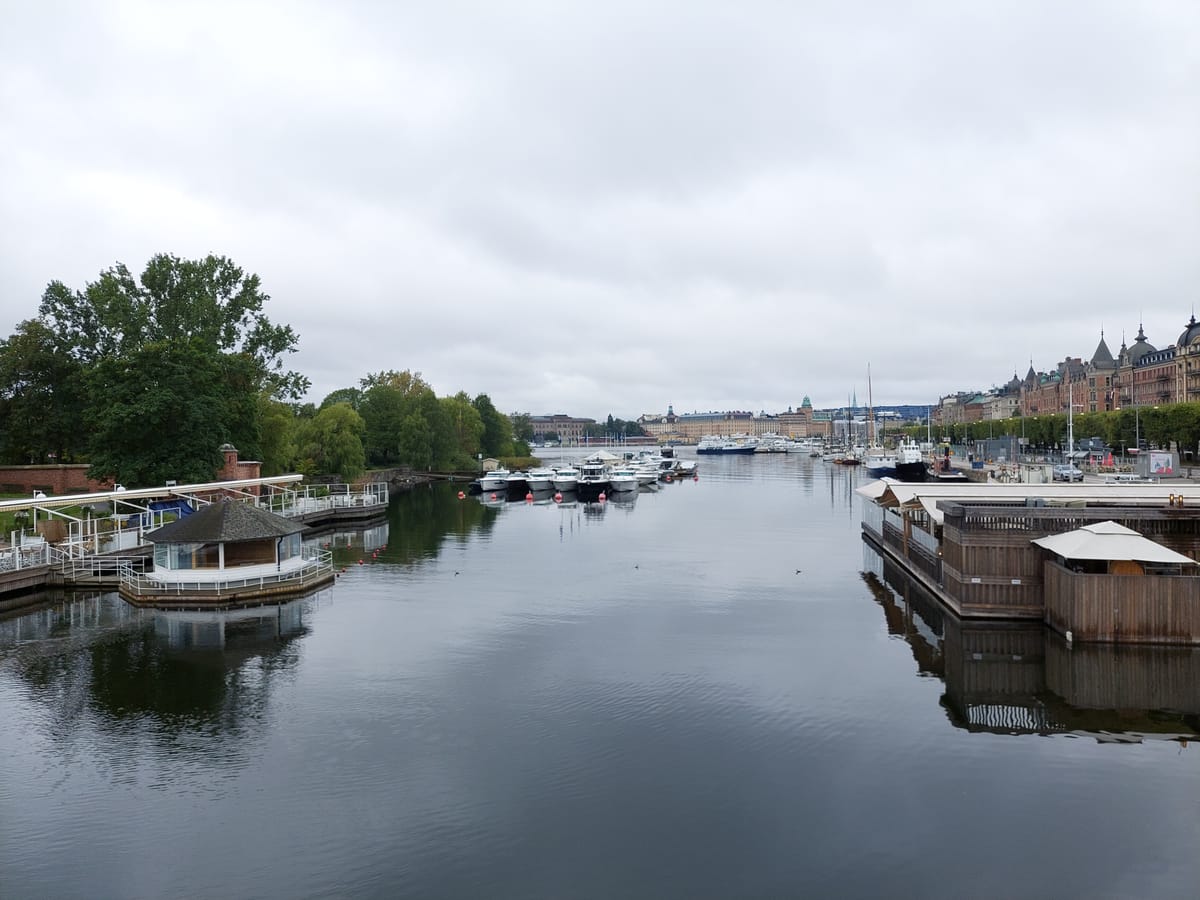
I walked from the area of the main train station, through the square at Sergels Torg, followed the street down to the harbor and then walked along the water until I crossed a bridge to the island where the museum stands. There were lots of touristy boats advertising archipelago tours. I don't particularly like those boats: they're squat constructions that make me claustrophobic. I prefer open boats, like ferries, for that kind of touring. Boats that let you see the sky and feel the wind on your face as you travel.
Along the way were little stands selling everything from ice cream to Swedish Fika. I got to the harbor early, so most of them were busy opening and setting up their signs along the walk. A white delivery van moved slowly behind me. It was the daily delivery of oysters and other shellfish for the boat-restaurants along the water. The driver, dressed in black, stopped every few meters, opened the back of the van, and placed one or two large white boxes at the door of a restaurant, then drove slowly forward. It eventually passed me, since it had run out of boat-restaurants to deliver to.
The Viking Museum isn't the only museum on the island. Not even the most famous. That would be the Vasa Museum, which holds a fantastically well-preserved wreck from 1628 that sank in Stockholm harbor on its maiden voyage. The Viking Museum is further down along the edge of the island, past a park, the hop-on-and-off dock, and the Spirit Museum, which, unfortunately, has nothing to do with ghosts or the supernatural, but celebrates the drinking culture of Sweden. Perhaps not the best place to visit before 9 in the morning.
You bought my ticket from a group of very pleasant young people, dressed in either peasant or warrior viking clothes. They spoke several languages: Swedish, German, English, Danish, Spanish. They made me feel instantly comfortable with the visit. We spoke English. Their Spanish was merely functional, and my Swedish is non-existent, so we compromised. They also didn't really speak Dutch, so we couldn't connect that way. English was the compromise. I got the usual two-minute mentions of what is most remarkable about the museum, took the ticket and climbed a steep flight of stairs, each one labeled with events and dates related to Viking history, to the exhibits.
There is a sample prow of a viking ship right at the entrance. I've been to the Ships Museum in Roskilde, Denmark, so I'm somewhat familiar with the basics of viking ship construction. I almost walked past it, until I realized that the descriptive texts alongside the exhibits had their titles written in runes.
I love runes. I am a fan of M. R. James, and his short story, Casting The Runes, has been made into a great movie, Night of the Demon. Whenever I see runes, my first thoughts are to that movie and that short story. Both scared the daylights out of me when I was younger. Perhaps because of this, runes have a magical halo around them, even though they are a straightforward alphabet used for recording important events and commercial transactions. The museum helpfully provides a board where you can write your name in runes, using a key that relates a rune to a particular letter of the alphabet.
The museum isn't large, but it is very well designed and very informative about the life of the Vikings. Every half-hour or so, one of the pleasant people from the entrance comes upstairs and provides a tour, in different languages, going over the exhibits, telling stories about what it meant to be a Viking, and giving additional color via questions-and-answers from the audience to keep everyone engaged. I listened to the English version for a while, but since I'm more comfortable discovering things for myself, I left the tour behind and explored the story of the Vikings via the exhibitions themselves.
My eyes were instantly drawn to the Viking figure standing at one end of the room. This was a 'reconstructed' Viking, someone who had lived around 500 CE. He had been reconstructed using the sculpture method that archaeologists use to rebuild the faces of the dead whose only remains are their skulls and bones. It is a fascinating process, very deliberate, very slow, and very detailed. There is a film that shows the highlights of the process of creating the character standing in front of you, how his face was reconstructed, then the clothes, then the rest of him until what you have in front of you is the summary of the archaeological knowledge about Vikings, applied to this particular reconstruction. I admit I did stare at him for far longer than I should have, but his is an irresistible presence, a travel-back-in-time moment. You can almost smell the thatch and the peat and the smoke on him.
There is a Viking helmet attached to a rail on a wall. If you stand under it, you can lower it (or raise it) to your height so it fits you properly. There is a shield next to it, and a lance you can grab, so you can have a perfect picture of yourself wearing a Viking helmet, ready for battle. A couple of the visitors really took to that exhibit, and the room filled with the roars of their battle cries while their companions took their pictures. There is also a throne room where you can pass judgement upon the people around you.
A few visitors tried their hand at hnefatafl, which is a Viking board game that reminded me of Go. You use your pieces to try to 'trap' the other player's king by surrounding him with your own. I watched the game for a while, but soon drifted away again, to visit the latter part of the exhibitions, where the exhibits talk about how the image of the Vikings has been shaped over the centuries by mass media of one form or another, from Wagner all the way to The Tartars and the Vikings television series.
Going down a flight of stairs, there is a 'ride', similar to what you get in amusement parks, with a car moving down a track, showing you exhibits. This particular ride tells the saga of Harold, who goes off to gather 3 barrels of silver to prevent his daughter from getting married off to some nasty candidate (her dowry would have covered Harold's debts). This was a delightful little experience, with the story told clearly, with style, and dioramas illustrating the highlights of the tale as it went along. It's very cleverly done and the story has a happy ending. Listening to the story in the dark tunnel was a great way to end the visit.
I had a long walk back to my hotel afterwards. The wind has started to pick up and I felt a bit hungry, so it was time to return to the current era and find a good place where they served vegetarian food. I may not return to the Viking museum the next time I'm in Stockholm. It would be impossible to recreate that first visit, with its surprises and explorations, but the experience was worth it, if only to be surrounded by so many strange and wonderful artifacts and their stories, all written in runes.