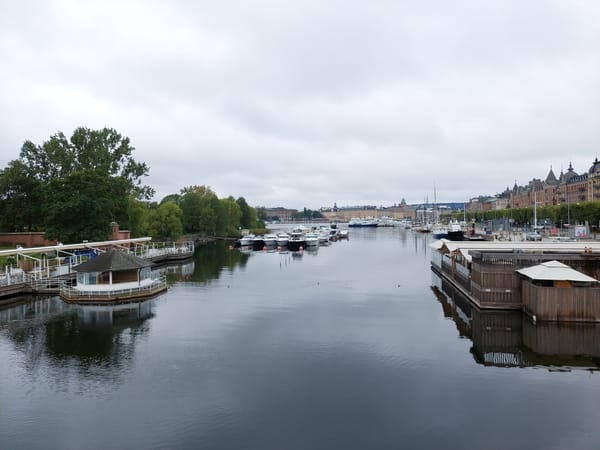
The Musical Island
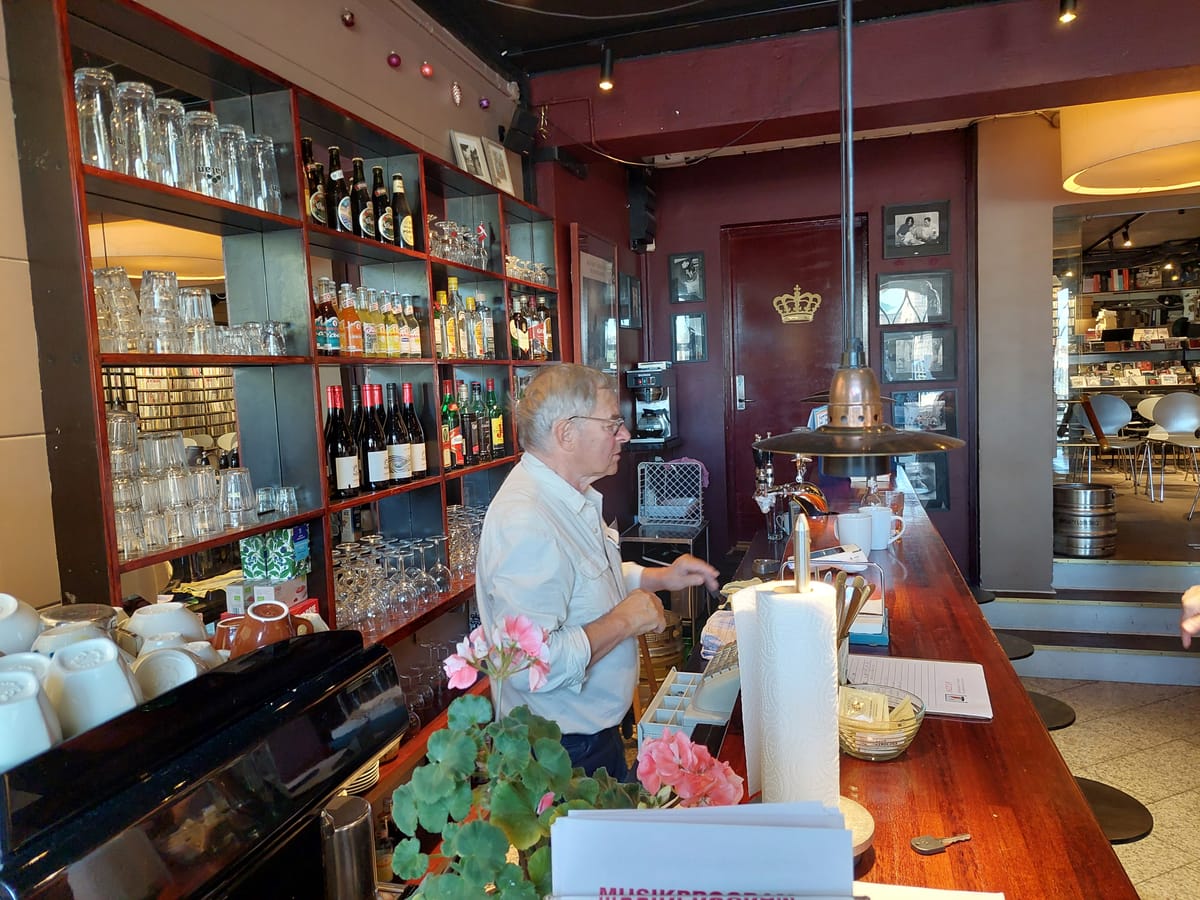
At first glance, the Jazz Cup is a unassuming little place tucked on the street facing a park. 5 wood tables surrounded by old fashioned wood chairs. A bar with a coffee machine, empty glasses, some wines and some stronger spirits arranged behind a wood counter. Above the bottles and glasses, Christmas lights left over from a long time ago hang on the wall. Next to the door, a very small rectangular stage. On the day of my visit, a drum set was waiting for the rest of the band to arrive.
It's when you get past the bar area that you notice an enormous collection of jazz music, on LP and on compact disk. Racks and racks of music ranging from the 1930s all the way to now. Beloved names, too many to mention, are all represented. The walls are covered with photos of jazz legends, some Danish, some from everywhere else. There are colorful reproductions of famous jazz posters.
Søren, the host, let me have some coffee after grinding the beans himself with his machine. He mentioned that a jazz band would be arriving in the afternoon to play and that I was welcome (after I paid my cover charge) to come in and enjoy them. I sat on the cushioned bench on one side of the room, next to the tables, and took my time drinking the generous cup of coffee that Søren provided for me.
I wondered how Søren could possibly sell the disks or albums except to the most dedicated audiophiles. I couldn't image there could be that many repeat purchasers of albums and CDs to support such large inventory. In the age of streaming, where every song ever created can be heard with a bit of diligent searching without the need of a physical recording. And yet, the Jazz Cup not only survives, but thrives. It lives by its own rules and has done so for many many years. These rules are unknown to me, a world apart.
I had the feeling that the Jazz Cup existed in its own reality, where many audiophiles indeed regularly purchase music and a dedicated group of listeners filled the space to hear live jazz played in the middle of the afternoon on a Saturday. I felt that world wrapping itself around me as I sipped my coffee. A musical island surrounded by an indifferent world.
I was alone with Søren for some time. He went about his business, cleaning the bar, arranging the latest arrivals on the shelves, making sure that there was enough beer, wine, and supplies for the upcoming afternoon concert. At some point, a friend stopped by to discuss which albums should go on the 'bargain bin' set outside the door. The friend was younger than Søren. He had a ponytail and a beard and wore a loose white shirt and khaki slacks. Once the friend was gone, Søren asked me where I'm from and we chatted for a while about what has brought me to Copenhagen.
I lie and tell him that I'm there for work. He doesn't question me, but he gives me a wry smile. He's seen people like me before. He knows them better than they know themselves. I tell him that I used to have a girlfriend who liked to listen to jazz and that's how I found myself in his club in the middle of a Saturday.
"Where is she now?" He asks. "Is she coming later?"
"No. She's busy with her work..." I lie again.
Søren nods carefully and turns back to his duties straightening out the place before the patrons arrive. The band arrives to rehearse and warm up. Søren greets them with free beers and bottles of water.
I imagine that Søren is the King of this musical island and that he rules it with a pleasant, friendly demeanor. It's easy to imagine it would feel good to live in Søren's Island, under his rule, surrounded by jazz and people who appreciate it. It would be easy to disappear from the world I know and the memories I hold. I would fill my days taking care of the music on the shelves, carrying beer kegs, restocking the bar and taking care of the customers who come to listen to the bands. I'm sure after a while I would stop thinking about the one who left me behind.
The regular patrons begin to arrive. They trickle in, in pairs most of them, men talking to other men, women with other women, sometimes in groups of four or six that are hard to accommodate in such a small space. Søren does his best to steer everyone around so they are comfortable and cannot block the way for other arrivals. A family comes in with two small daughters. A couple brings their young son. Little by little, the Jazz Cup fills to the brim with the sound of conversation until it overfills with people taking every available chair all the way to the back of the room.
I find my place in the back, away from everyone. An older woman and her daughter sit next to me. They talk in Polish to each other. After a while, the older woman leans forward and asks "Do you know anything about plants?"
I ask what she needs and she raises her phone to show me a photo of a dried lotus seed pod. She tells me that she used to make pottery and that she based it on the shape of the seed pods, but that she could not remember the name of the plant itself.
I tell her, and enjoy her thanks.
Then I return to the comfort of my silence.
The music is starting. Søren is busy attending to everyone. He doesn't see me anymore. Each person is locked in their head, listening to the band play, following the rhythm in their own separate way. The music is shared but the experience isn't.
I wonder what she would make of it.